
Vortex Flowmeter
Product Overview
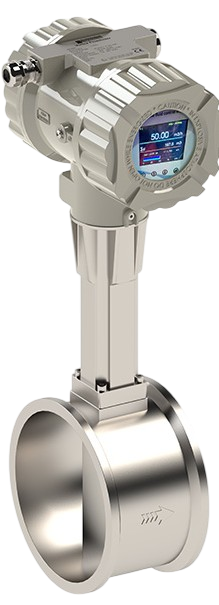
A Vortex Flowmeter is a type of industrial flow measurement instrument used to determine the flow rate of fluids (liquids, gases, and steam) flowing through a pipeline. It operates on the vortex shedding principle, where alternating vortices form behind a bluff body placed in the flow stream. These vortices are detected by a sensor and converted into an electrical signal proportional to fluid velocity and flow rate. Vortex meters are widely chosen for their simplicity, wide applicability, and low maintenance in many sectors such as steam systems, process fluids, HVAC, petrochemical, and general industrial control systems.
Our Innovations
Industry Focused Products!
How it works (simple explanation)
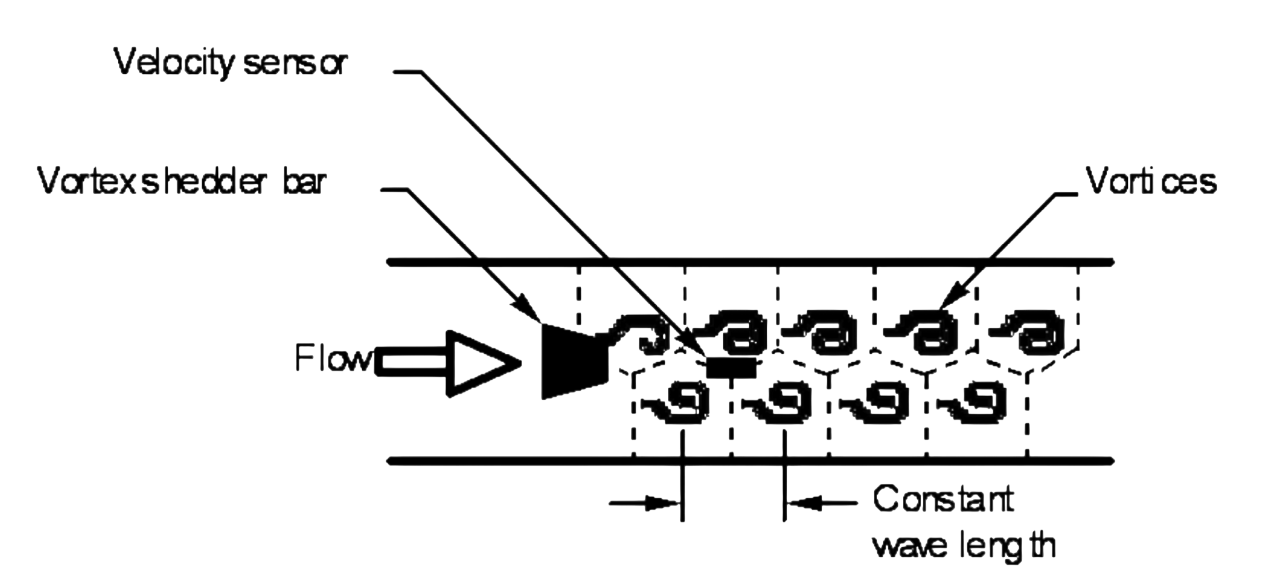
- A bluff body (shedder bar) is installed in the flow path inside the meter.
- As fluid flows past this obstruction, it creates a pattern of alternating vortices on either side — known as a Von Kármán vortex street.
- The frequency of these vortices is directly proportional to the fluid’s flow velocity.
- A sensor (often piezoelectric) detects the pressure variations caused by vortex shedding and converts them into an electrical signal.
- The flowmeter’s electronics process this signal to calculate volumetric flow rate and, with compensation, can also infer mass flow.
What it measures
- Volumetric flow rate (e.g., m³/h, L/min) by correlating vortex frequency to flow velocity.
- Totalized flow over time (cumulative volume).
- With additional temperature and pressure inputs, they can derive compensated mass flow for gases and steam.
- They work for liquids, gases, and steam across a broad range of conditions.
Key advantages
- No moving parts — high reliability with low wear and maintenance.
- Low pressure loss — typically lower than orifice plates, helping preserve system energy.
- Wide fluid compatibility — suitable for liquids, gases, and steam. Good turndown ratio — wide measurable range (often 10:1 to 40:1).
- Stable long-term performance — minimal zero drift and reliable K-factor over time.
- Insensitive to minor changes in viscosity, density, and pressure (within operating range).
Applications
- Process industries — petrochemical, chemical, and refinery processes.
- HVAC systems — chilled water, cooling circuits, and building energy monitoring.
- Compressed air and gas systems — measurement of compressed air, nitrogen, and other gases.
- Water and liquid flow — clean liquids in industrial and municipal applications.
Installation
- Ensure straight pipe runs upstream and downstream (typically 10× diameter upstream, 5× downstream) to form stable vortices.
- Install the meter perpendicular to flow direction with correct orientation.
- Choose appropriate flow conditioning if upstream disturbances (valves, bends) cannot be avoided.
- Maintain system cleanliness to avoid deposits on the shedder body.
- Provide correct electrical grounding and signal wiring for electronic outputs.
- Consider integrated temperature/pressure compensation (especially for gas/steam) for best accuracy.
Technical Specifications
Parameter | Specification |
Measurement Principle | Vortex shedding (Von Kármán vortex street) |
Measured Fluids | Liquids, gases, steam |
Flow Range | ~0.3 to 10 m/s (liquids), ~5 to 80 m/s (gases) (velocity basis) |
Accuracy | ±1% (liquid), ±1–1.5% (gas) typical (model dependent) |
Turndown Ratio | ~10:1 to ~40:1 (type & fluid dependent) |
Pressure Rating | Up to ANSI Class 1500 / PN ~250 (model dependent) |
Temperature Range | ~–40°C to +350°C (varies by model) |
Outputs | Pulse frequency, 4-20 mA, digital communication (HART/Modbus) |
Installation Orientation | Horizontal or vertical with proper runs |
Pressure Drop | Low (≈1/4–1/2 of orifice plate) |